Knowing isn’t
steering.
A language model can separate real entities from invented ones perfectly in its activations and still make up an answer about them. The direction that carries that knowledge sits about 83° from the direction that produces a refusal, and the angle holds across four models from three families.
Perfect Detection, Failed Control: The Geometry of Knowing vs. Steering in Language Models · arXiv:2606.24952

- 1.000
- AUC of a linear probe for fake vs real entities, from layer 5
- ≈ 83°
- between the detection and refusal directions (cos = 0.12)
- 0.12–0.20
- the same cosine across four models from three families
- 13% → 60%
- refusal on subtle fakes after a 15° rotation, at 1 false positive in 55
01A model that knows, and answers anyway
Ask Gemma 2-2B-it for the capital of Norlandia, a country that does not exist. Most of the time it answers. Inside the model, the picture is different: by layer 5 a linear probe tells invented entities from real ones with an AUC of 1.000. The model has the information it would need to decline. It doesn’t use it. §2.7, §4.1, §4.2
Much of mechanistic interpretability rests on a quiet assumption. Find the direction in a model’s activations that represents a behaviour, and you can steer the behaviour by pushing along it. That only works if the direction that detects a behaviour is the one that controls it, or close to it. We set out to test that assumption. §1
We frame it as geometry. In the residual stream, take the direction that best separates fake entities from real ones, and the direction that, when added, makes the model refuse. If detection implies control, the two should point the same way, at a cosine near 1. We call the cosine between them the detection-intervention gap: the cosine between a direction that reads a behaviour and the direction that changes it. It is the central quantity of this work. §1, §2
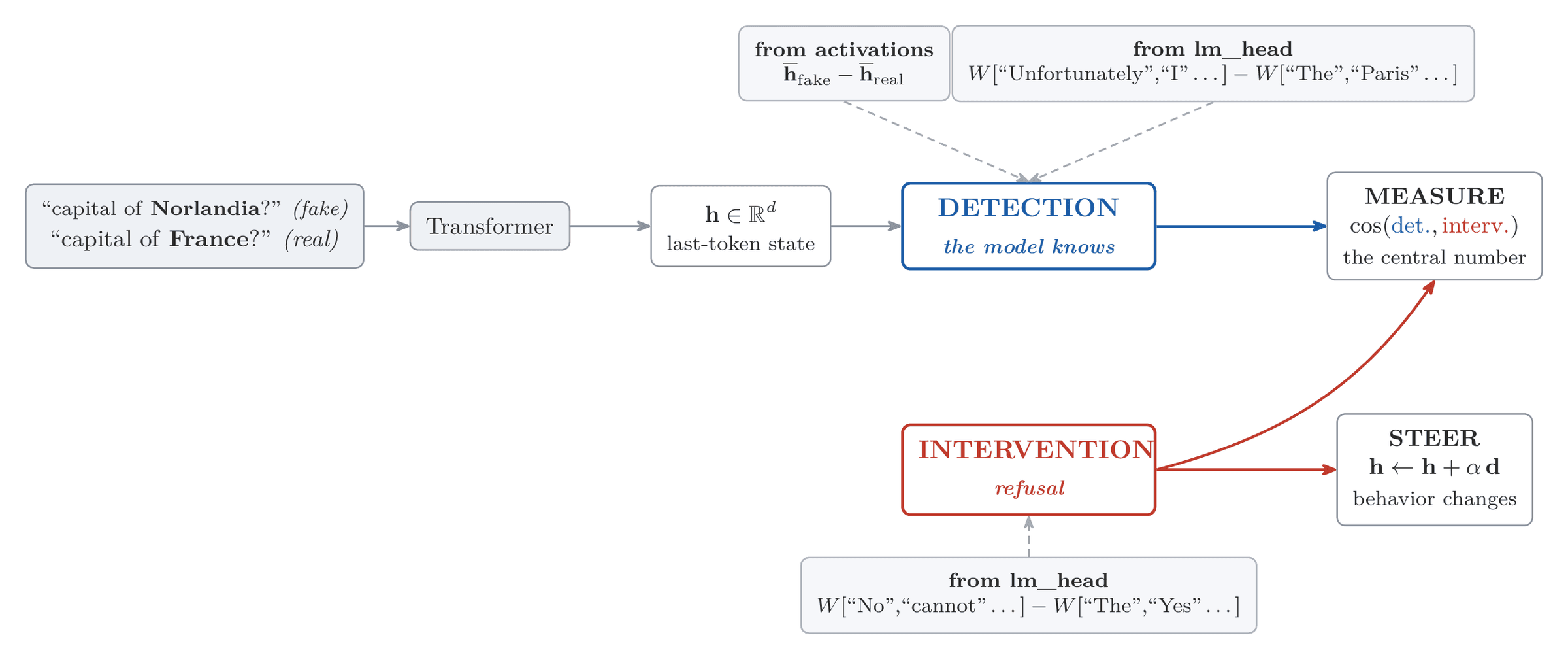
lm_head), and an intervention direction for refusal, from lm_head alone. We measure the cosine between them and steer by adding a direction during generation. Figure 1, arXiv:2606.24952.lm_head rows of two token sets. Detection contrasts cautious openers (“Unfortunately”, “I”) with confident ones (“The”, “Paris”). Refusal contrasts “No”, “cannot” with “The”, “Yes”.02Where detection is control
We start with a behaviour where the assumption holds. Asked for JSON, Gemma 2-2B-it wraps it in markdown code fences 100% of the time. The decision between { and ``` forms at layers 20–25, peaking at layer 24. §3, §3.1
A single direction, the difference between the lm_head rows for { and ```, does both jobs. Project the last-token state onto it and fenced output separates from clean. Added at layers 20–25 with strength α = 3.5, it removes fencing on every query, with 100% valid JSON and 100% correct answers. The switch is sharp: below α = 2.5 every reply is fenced. The push is 0.6% of the activation norm. None of 100 random directions and none of 10 irrelevant token-pair directions has any effect. §3.2
Format also transplants cleanly. Activations from a clean-JSON pass, injected into a fencing pass at layers 20–25, remove the fence 10/10 times. Format is an overlay: a rendering choice that rides on top of the content. §3.3, §3.4
One caveat matters later. A data-driven direction built from fenced and clean activations is a different vector, nearly orthogonal to this one. Format is the aligned case because one vector serves both roles, not because two independent constructions agree. §3.2
03Six detectors, one verdict
Hallucination is the opposite case. We read the fake/real distinction six independent ways, supervised and unsupervised. Every one succeeds. A probe separates the two perfectly from layer 5; so does a single attention head. A single MLP neuron, a single sparse-autoencoder feature and even the norm of the entity’s input embedding each carry the signal. §2.3, §4.1
The signal is graded, not binary. The same head separates obscure real entities from common ones at an AUC of 0.993. The model tracks how well it knows an entity, not only whether the entity exists. Because obscure and common entities are matched on surface form, this also argues against a probe that only picks up the wording of the prompt. §4.1
04Pushing on what the model knows
Detecting is not acting. The data-driven direction, which separates fake from real at an AUC of 1.000, goes the wrong way as an intervention: adding it reduces refusals and increases fabrication. Its top tokens are semantically mixed, which suggests it captures differences in prompt structure rather than the behaviour. §4.2
The hand-picked detection direction helps, but only partly. At α = 15 on layers 20–25, fabrication on fake entities falls from ~70% to ~40% (p < 0.001), with 0 false refusals on the 50 real questions. §4.2
Other routes do nothing. Amplifying the SAE feature up to 50× leaves refusal unchanged and costs 2 real answers. Ablating the 500 most discriminative neurons at layer 15 changes no behaviour. Detection succeeds by every method we tried. Only output-vocabulary directions have causal power, and even they are limited. §4.2
05An angle of 83 degrees
The cosine between the hand-picked detection direction and the refusal direction is 0.12, about 83°. Between the data-driven detection direction and refusal it is −0.06. Both are far from the cosine of 1 that “detection is control” would require. §4.3
The two numbers are not the same kind of measurement. In 2,304 dimensions, two unrelated directions sit at a cosine of about 0.02 by chance. The 0.12 is about 6× that floor and repeats across models, so it is a small but real alignment. The −0.06 is at the floor. §4.3
There is also no single detection direction to measure. The hand-picked and data-driven detectors both reach an AUC near 1, yet they are nearly orthogonal to each other, at a cosine of 0.11. A whole family of directions detects. Every member we built is far from the direction that acts. And because the data-driven one uses no lm_head rows and no chosen tokens, the gap is not an artifact of how we picked them. §4.3
06Why the signal never reaches the output
The detection signal is large. At layer 25, fake entities project 49.8 units further along the detection direction than real ones, 6.9× the mean gap of 2,000 random directions. Along the same axis, the refusal gap is -24.9: the wrong sign. §4.3
The output is dominated by something else. For “Capital of Norlandia?”, the logit lens at layer 25 predicts the fragment ‘Nor’ with ~99% probability: the model is set to copy the entity name. The part of the residual orthogonal to detection, mostly this entity copy, is about an order of magnitude larger than the detection component (median ~12× across fakes). This holds even more strongly for real entities, so it is a general property of the output mapping, not a mark of the failure. §4.3
Worse, the detection direction pushes the wrong tokens. On fake entities it lowers refusal tokens such as “fictional” and raises fabrication openers such as “The”. Remove the detection component from the residual stream altogether and “Norlandia” still maps to ‘Nor’ with essentially unchanged probability. The output mapping does not see the signal. §4.3
Most of the signal comes from MLPs. Decomposed by sublayer, MLPs contribute +42.3 to the cumulative gap and attention +7.5, a ratio of 5.66×. Layers 18–25 each add roughly +5 to +7. No single layer dominates: at any one MLP output the gap is ~0.01, and the ~50 exists only as a sum. A self-intervention gate built on one layer’s reading matched the baseline in all 9 conditions we tried. §5.1, §5.3
Late attention is dispensable. Running layers 17–25 with MLPs only raises refusal of fakes from 60% to 75% on the subset we tested, while real answers stay 95% correct. Attention through layer 16 is essential: run layers 13–25 with MLPs only and refusal falls to 5% while real answers fall to 0%. §5.2
07A 15° turn
If the problem is direction, a different direction should help. We rotate the detection direction toward refusal, keeping it in the plane they span: cos θ times the detection direction, plus sin θ times the part of refusal orthogonal to it. At θ = 15°, the result keeps 0.966 of the detection direction and adds 0.259 of the action component. §6.1, §6.2
We chose the angle on a small sweep of 20 fake and 20 real entities, where most differences between angles are within one or two samples. That sweep only shows the range is broadly effective. The test is a separate, harder set of 115 questions, with categories fixed from the stimuli before any intervention ran. §2.7, §6.2
At α = 15, refusal of obviously invented entities rises from 40% to 73%. The harder case is Type 2: fabricated facts built around plausible dates, numbers and institutions, which carry no phonological hint and which the model nearly always accepts. Refusal there goes from 13% to 60%. One real question in 55 is wrongly refused, an arguably borderline case. At α = 10 there are no false positives, and the gains are smaller. §6.3
The rotation recovers much of the refusal behaviour, not all of it. We read it as evidence that the gap has geometric structure that can be partly bridged, not as a finished fix. §6.4, §8
08The same angle in four models
We repeated the measurement on three more models, each with directions built from its own lm_head. The cosine stays between 0.12 and 0.20, angles of 78° to 83°, across three families, three tokenizers and two scales. It is the consistency of a small positive, not its size, that is invariant. §7.1
The geometry predates alignment. On the Gemma 2-2B base model the cosine is 0.1197; after instruction tuning it is 0.1200, a difference of 0.0003. What tuning changes is where activations land along the fixed axis. In the base model the order is backwards, with real entities projecting further (gap -23.2). After tuning, fakes do (gap +49.8). The direction is multilingual from pretraining: its top favoured tokens include “Unfortunately” (0.809) and the Italian “purtroppo” (0.46). §7.5
The direction steers other families too, from whichever side the model starts. On small sets of 15 fake and 15 real questions, Qwen goes from 40% refuse to 93% refuse at α = +5. Llama, which refuses every fake by default, fabricates on 80% of them at α = -1. Neither loses a real answer. The strength does not transfer: Gemma needs 15, Llama 1, Qwen 5. Gemma 2-9B-it reproduces the geometry but resists the steering, so we report no comparable intervention for it. §7.3, §8
Llama turns the result into a double dissociation. Its detection direction is as orthogonal to refusal as Gemma’s, yet it refuses fakes and answers real questions. Its refusal cannot be running through that direction. Gemma detects with little action; Llama acts on a path that does not go through detection. That is the standard pattern for showing two functions are distinct. How Llama’s routing works is still open. §8
09A signature, not a test
It is tempting to use the cosine as a steerability test: high means the detection direction is itself a control knob, low means rotate first. We tested that reading, and it does not hold. §8
Measured the same independent way, with a data-driven detector against the intervention direction, the cosine sits near the chance level for format and hallucination alike. Format’s cosine of 1 comes from using one vector in both roles. And since detection occupies a subspace rather than a single direction, the one number such a test would need does not exist. §3.2, §4.3, §8
What separates the two cases is functional: whether the direction that steers also detects. For format it does (AUC ≈ 1). For hallucination the refusal direction reads fake against real only at AUC ≈ 0.7, while the dedicated detector still reaches 1.000. That is a fact about behaviour under intervention, and a static angle cannot show it. The cosine is a robust signature of the dissociation, computable from the weights and invariant across four models. It does not predict how steerable a behaviour is. §8
10Where it falls short
- Samples are small. Most experiments use 20–55 questions per condition. The angle sweep (N = 20) is underpowered for choosing an angle precisely.
- Models are small and of one kind. Three families, all decoder-only transformers, from 1B to 9B parameters. Models above 10B and other architectures are untested.
- One behaviour, studied in depth. The analysis centres on hallucination about non-existent entities, with format as a positive control. Other behaviours may show different angles.
- The entity-copy dominance is unexplained. We document it but do not know how it emerges in pretraining, or whether it is specific to entity-centred questions.
- The directions assume a linear unembedding. This holds well at 1–3B parameters. Nonlinear probes on larger models may show a different, possibly larger, gap.
- Difficulty tiers are not sharp. The Type 1 and Type 2 labels were fixed before any intervention, but a human judge could place some questions differently. The aggregate false-positive rate is unaffected.
- Steering vectors are not identifiable. We tested 5 direction variants per behaviour and the pattern held, but an untested direction could break it.
A model can register perfectly that an entity is invented and still have no direct way to act on it: what it knows and what moves its output lie in nearly orthogonal directions. The cosine between them is a robust signature of that gap, laid down in pretraining, not a dial for how easily it can be closed. §8
—Citation
This page retells the paper for a wider audience. The paper on arXiv is the reference for every method detail, number and caveat.
Galeone, C., Ettorre, A., Park, M., Ettorre, G., & Ligorio, D. (2026). Perfect Detection, Failed Control: The Geometry of Knowing vs. Steering in Language Models. arXiv:2606.24952.
@misc{galeone2026perfect,
  title         = {Perfect Detection, Failed Control: The Geometry of Knowing vs. Steering in Language Models},
  author        = {Galeone, Cosimo and Ettorre, Anna and Park, Minsu and Ettorre, Giuseppe and Ligorio, Daniele},
  year          = {2026},
  eprint        = {2606.24952},
  archivePrefix = {arXiv},
  primaryClass  = {cs.CL},
  url           = {https://arxiv.org/abs/2606.24952}
}
Photographs from Unsplash. Figures marked with a figure number are reproduced from the paper.